
Search Salt Lake City Felony Records
Salt Lake City felony records are maintained by the 3rd District Court and the Salt Lake City Police Department. Salt Lake City is the state capital and Utah's largest city, with around 200,000 residents. Felony cases here go through the Salt Lake County court system, and records from those cases are public documents under Utah law. This page covers how to search Salt Lake City felony records online, how to request police records under GRAMA, what court filings contain, and where to find conviction history through the state Bureau of Criminal Identification.
Salt Lake City Quick Facts
How to Access Salt Lake City Felony Records
Felony records in Salt Lake City are split between court records and police records. Court records come from the 3rd District Court and include case filings, charges, verdicts, and sentencing orders. Police records come from the Salt Lake City Police Department and include arrest reports and incident documentation. Each source covers a different part of the felony process, so you may need both to get a full picture.
The fastest way to start a felony records search for Salt Lake City is through the Utah Courts XChange system at utcourts.gov/xchange. XChange lets you search by name or case number. Guest sessions cost $5 per session plus $0.20 per search result. A monthly subscription runs $40. Free public terminals are available at the 3rd District Courthouse in downtown Salt Lake City, located at 450 South State Street. You do not need an account to use the in-person terminals.
The Utah Bureau of Criminal Identification runs a separate name-based search. BCI charges $15 for a name check and can be reached at (801) 965-4445. Their database pulls from statewide conviction records, which includes felony convictions from Salt Lake City cases. Go to bci.utah.gov to learn more about BCI record services.
Note: Court records and BCI records cover different things. Court records show what was filed and decided. BCI records show final conviction history based on what courts reported to the state.
Salt Lake City Police Department Felony Records
The Salt Lake City Police Department keeps arrest records, incident reports, and related files for crimes that occurred within city limits. When a person is arrested on felony charges in Salt Lake City, the police department creates a report. That report becomes a public record under the Government Records Access and Management Act, Utah Code Title 63G Chapter 2. You can request a copy through the department's GRAMA process.
The Salt Lake City Police Department accepts records requests online and in person. In-person requests go to the Public Safety Building Service Desk lobby at 475 South 300 East, Salt Lake City, UT 84111. Walk-in hours run Monday through Friday, 12 p.m. to 4 p.m., and the office is closed on holidays. You will need a valid photo ID such as a driver's license, passport, or permanent resident card.
The following image shows the Salt Lake City Police GRAMA records request page. This is where residents submit requests for police reports related to felony arrests in Salt Lake City.
Source: police.slc.gov/resources/grama-records-request
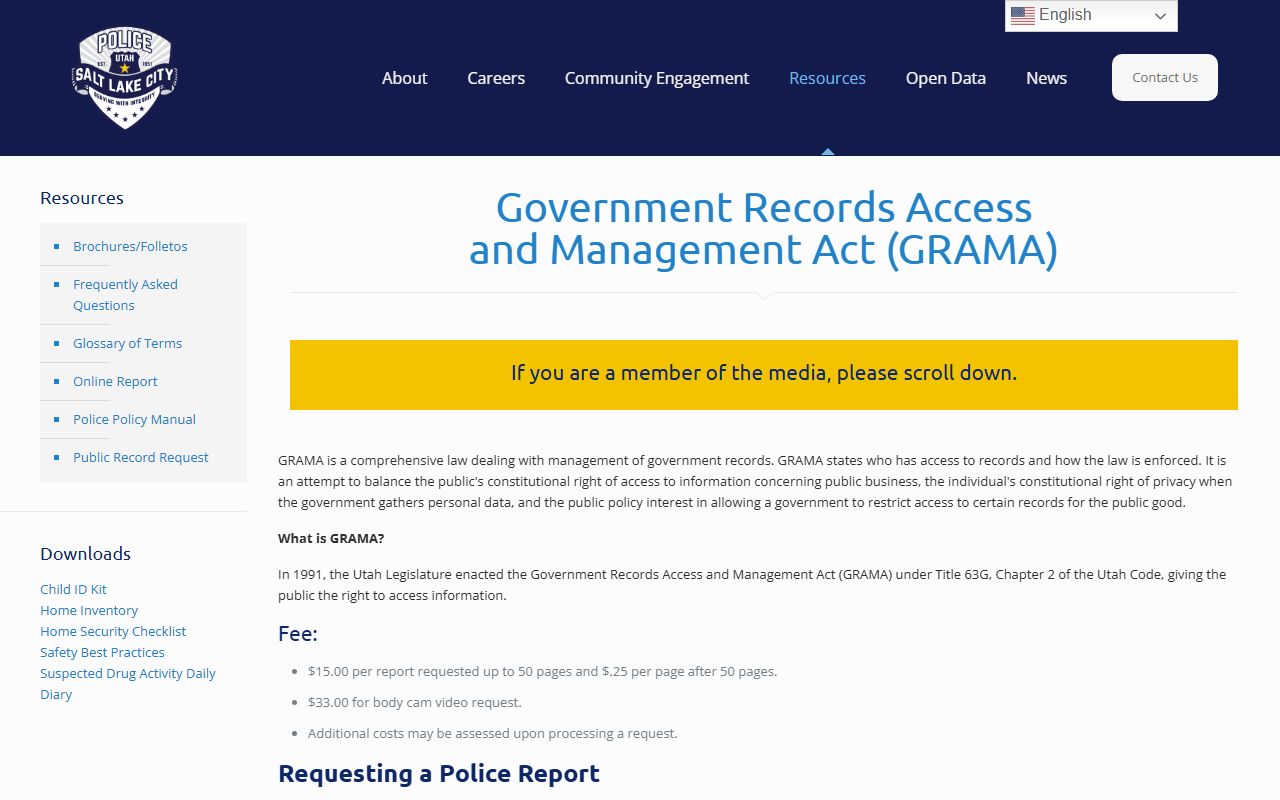
The online portal lets you submit your request without visiting in person. Most requests receive a response within 10 business days. Police report fees in Salt Lake City are $15 per report for up to 50 pages and $0.25 per page after that. Traffic accident reports also cost $15 each. Staff time beyond the first 15 minutes is billed at $20 per hour under GRAMA rules, while redaction time runs $46 per hour.
3rd District Court and Salt Lake City Felony Cases
All felony charges filed in Salt Lake City go through the 3rd Judicial District Court. This court handles felony arraignments, preliminary hearings, trials, and sentencing for the entire county. The main courthouse sits at 450 South State Street in downtown Salt Lake City. Phone: (801) 238-7330. The court is open Monday through Friday during standard business hours.
Felony case records from the 3rd District Court include the criminal complaint or information, bail and bond orders, hearing transcripts, jury instructions, verdict forms, and the judgment of conviction or acquittal. Sentencing orders and any probation terms are also part of the record. These documents are filed under the case number and remain public records unless the court orders them sealed. Searches on XChange will show the docket, which lists every filing in the case with dates.
The Salt Lake County District Attorney prosecutes felony cases originating in Salt Lake City. The DA's office can provide case status information for victims and their families. Visit saltlakecounty.gov/district-attorney for contact details and victim services.
The image below shows the Salt Lake County District Attorney's office page, which handles felony prosecution for Salt Lake City cases.
Source: saltlakecounty.gov/district-attorney
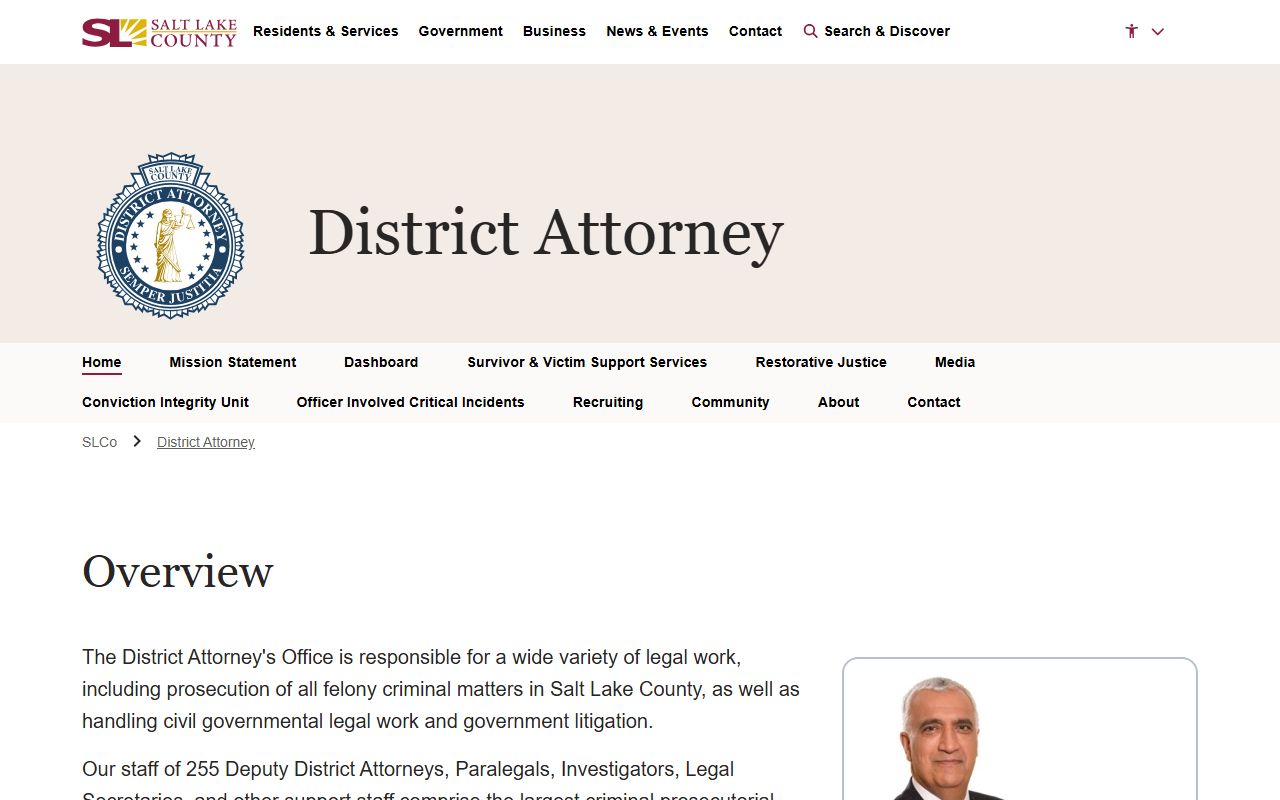
The District Attorney's office works alongside the 3rd District Court to move felony cases from initial charge through to resolution. Salt Lake City felony records from this process become part of the permanent court file.
Note: The 3rd District also has a West Jordan courthouse at 8080 South Redwood Road. Salt Lake City cases generally go to the downtown location, but this can vary based on case type and scheduling.
What Salt Lake City Felony Records Include
A felony record in Salt Lake City can mean several different things depending on where you look. Police records from the Salt Lake City Police Department focus on the arrest: the date, location, charges, and the officer's account of events. Court records from the 3rd District cover the legal proceedings from the first appearance through sentencing. BCI records reflect the final conviction outcome as reported to the state.
Court felony records in Salt Lake City typically include:
- Criminal complaint or information listing the charges
- Arrest warrant or summons if one was issued
- Bail determination and any bond conditions
- Plea entered by the defendant
- Trial dates, continuances, and hearing notes
- Verdict or judgment of the court
- Sentencing order including prison term, fines, and probation
Not all details are always public. Some parts of a file may be sealed by the court or restricted under GRAMA. Juvenile records are handled separately and are not public. Records involving ongoing investigations may also be withheld.
Utah Felony Classes in Salt Lake City Cases
Utah law defines felony crimes under Utah Code Title 76. The state uses four felony levels. Capital felonies carry the most serious penalties and include crimes like aggravated murder. First degree felonies carry five years to life in prison and fines up to $10,000. Second degree felonies carry one to fifteen years in prison and fines up to $10,000. Third degree felonies carry up to five years in prison and fines up to $5,000.
The class of a felony determines where a person serves time. First and second degree sentences often mean a term in a Utah Department of Corrections facility. Third degree sentences can result in jail time or probation depending on the judge's order. All felony classes create a conviction record that shows up in the 3rd District Court file and in BCI records for Salt Lake City cases.
Note: The Utah Department of Corrections at corrections.utah.gov maintains offender search tools for people currently in state custody or on supervision.
Expungement of Salt Lake City Felony Records
Some felony convictions in Salt Lake City may be eligible for expungement under Utah law. Expungement clears the record from public view and seals it from most searches. Not every felony qualifies. Capital felonies and first degree felonies are generally not eligible. Certain second and third degree felonies may qualify after a waiting period following the completion of the sentence, including any probation or parole.
The Bureau of Criminal Identification handles the expungement certificate process in Utah. Once BCI issues a certificate of eligibility, the petitioner files in the court where the conviction occurred, which for Salt Lake City cases means the 3rd District Court. The court then decides whether to grant the expungement. Learn more about eligibility and steps at bci.utah.gov/expungements.
Salt Lake County Felony Records
Salt Lake City is in Salt Lake County. All felony cases from Salt Lake City go through the Salt Lake County court system. For more county-level resources, including information on the county sheriff, county court locations, and broader felony record access options, visit the Salt Lake County felony records page.
Nearby Cities in Salt Lake County
Other cities in the Salt Lake area use the same 3rd District Court for felony cases. Select a city below to find felony records information for that area.